Why David Hockney is a men’s style icon
The British artist is as much a master of painting with colour as he is in wearing it
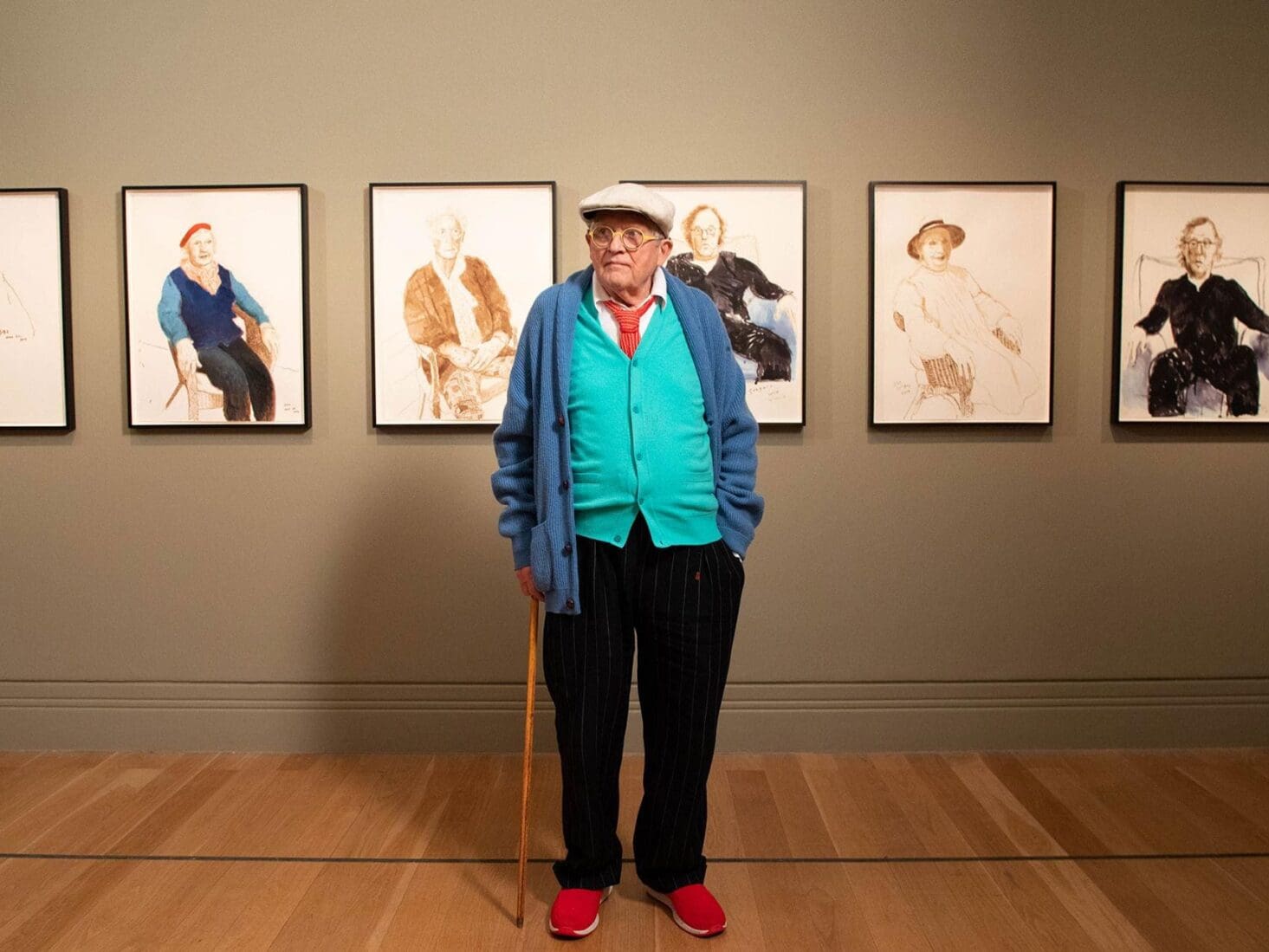
Perhaps the National Portrait Gallery has missed a trick. Once you have taken in the wondrous works of its new exhibition, David Hockney: Drawing from Life, the first major exhibition of his drawings in 20 years, exiting through the gift shop presents the opportunity to buy Hockney-inspired totes, coasters, puzzles, pots and egg cups. Granted, there are some socks, but where are the ties, scarves, caps and the specs? For while David Hockey may be the most highly-valued living artist – one of his swimming pool paintings having sold for £70.3m in 2018 – the 82-year-old is also a bona fide style icon.
From his way with clashing colours to his skill for mismatching outfits, from his accessories to his hair, Hockney has created a look for his dress as distinctive as that which he has created for his paintings. Of course, Hockney’s real contribution to the world is the vision of his art. But, looking beyond that for a moment, there’s a lesson to be had from his dress sense, too – even now. What’s crucial to take away from David Hockney’s style is its defiance. Follow the style guides, all that dress etiquette, and very little of the way he has dressed for the past 60-plus years should work. And yet it does. It makes, to borrow the title of one of his more famous works, ‘a bigger splash’.
Carefully Messy
Some men get to an age when – and who can blame them – they start to let things go. They look dishevelled. Hockney has looked that way since his 30s, and quite consciously so. His ties are slightly loosened and/or skewwhiff. The soft, often penny-collared shirts he’s long favoured may have the collar not laying quite properly. One of his shirt buttons may be undone. The back edge of his suit jacket collar may be turned up. The white pumps that he has on, maybe with a suit, are a little battered, a little bit grubby. He’s layered up – shirt, tie, knitted waistcoat, soft, crumpled tailored jacket – because that gives more scope for sartorial expression. The Italians have their own 16th-century term for such a way of dressing: sprezzatura. It’s a nonchalance in dress that conceals the artfulness behind it. That’s Hockey style down to a T.

Clashing Colour, Pimped-up Pattern
Hockney’s paintings have often been an expressionist riot of colour. And so with his dress. If there’s a brighter shade – a leaf green, a mustard yellow, the azure blue of his pool paintings – Hockney has worn it, often at the same time. Check out his socks – they’re often odd, one red, one green maybe, and that’s not because he’s dressed in a hurry. He’s made the same signature out of patterns – horizontally-striped rugby shirts and cardigans are a favourite – managing to mix and mismatch them in ways that might clash on anyone else, but which ring true on him. Polka dot ties with checked suits; pinstriped trousers with tattersall shirts; striped shirts with herringbone caps – it all just works. Check out the cover of 1975’s David Hockney by David Hockney: My Early Years Book – who else could pull off such bold stripes on stripes like that?

Pop Art Prep
Picture typical preppy style – the easy suits, the loafers, the casual shirts and the knitted ties of the Ivy League 60s – and it’s a very American vision. Yet Hockney dabbles with the look – especially its luxuriousness, and its occasional eccentricity – in a decidedly British way. It’s undercutting the values at work behind preppy looks – privilege, power, education – and channelling them through a counter-cultural art school sensibility. Hockney was in his early 20s when American culture began to trickle into the UK via magazines and movies during the 1950s. The younger Hockney dabbled with Americana through graphic t-shirts and collegiate sweatshirts. The older Hockney made preppy his own – more the principal than the pupil.
It Pays to Accessorise
If Hockney has a consistent image over the decades that’s because of one thing: his glasses. Like anyone who wears glasses and is ready to experiment with their frames, there’s quickly the understanding of how they can become a calling card. Of course, there’s a fine line between individualistic and wacky. But with his characteristically round horn-rimmed specs – sometimes more heavyweight, sometimes in a bright colour – Hockney’s always been on the right side. He’s made a brand of his face. But then Hockney has long had a penchant for an accessory: braces or boutonniere, a flouncy pocket square, some flamboyant neckwear, be that a bow-tie, scarf, or even a scarf worn as a tie. There’s his regular flat cap – well, he is a Yorkshireman – and usually a Camel cigarette on the go. “You can’t have a smoke-free bohemia,” he once noted.
Blonde Bombshell
Hockney still has his hair – a messy grey crop. Just check out Self Portrait with Red Braces. But for much of the 1960s, ’70s and beyond it was bottle blonde. It was in 1960s New York that Hockney saw a Clairol TV ad, intoning that ‘everybody should go blonde’. It probably wasn’t aimed at a man from Bradford, but Hockney dyed his hair there and then. If Andy Warhol wore a platinum blonde wig – one of a collection of around 40 – to create a kind of New York club character, Hockney embraced his Pop Art ’do for decades. He even made it the subject of one of his works, The Start of the Spending Spree and the Door Opening for a Blonde. Was Hockney playing with gender stereotypes? Certainly his dye job was a bold move more than half a century ago. But, with his glasses, look how it made an icon of the artist, never mind of his work. Could a thatch of roughed-up blonde locks be working for someone else in the same way?

Octogenarian Plus
Now that Hockney is in his 80s, he might well settle into those staples of old mannish dressing: a comfortable pair of slacks and a nice cardie. But Hockney has worn that kind of look long before anyone might call him old. A pair of loose-fitting – nay, baggy – trousers, whether in some formal chalk-stripe, or a more casual chino-style cotton, has been central to the Hockney look, often worn with a pair of pumps long before wearing formal trousers with trainers became a thing. Likewise, there’s rarely a Hockney get-up without some knitwear involved, regardless of the outfit: a crewneck sweater appears under a suit, a V-neck with a tie, even a cardigan over a V-neck. He must feel the cold. No, of course not – he’s just that cool.
David Hockney: Drawing from Life, 27 February – 28 June 2020, £18-20, exhibition free for members, National Portrait Gallery, npg.org.uk